What is RTP in slots, in plain words: how it is calculated and what it means in practice

Last updated: 12 November 2026
RTP is the share of all bets that a slot returns to players as winnings over the long run. An RTP of 96% means that out of every 100 coins staked, players collectively get 96 back and 4 stay with the casino.
The key words here are “over the long run”. We checked this against the public data of 7 649 games and against 200 000 reproduced spins in each of 12 popular slots. Below: what RTP is, how to read it and what not to expect from it.
At a glance: key facts about RTP
| Question | Answer |
|---|---|
| What it is | The share of bets that is returned to players as winnings over the long run |
| What it stands for | Return to Player |
| How it is calculated | All payouts ÷ all bets × 100% |
| What stays with the casino | 100% minus RTP — this is the house edge |
| Typical value | 96.00–96.70% — for 84% of the 7 649 games we checked |
| When it “converges” | Over millions of spins, not in a single session |
| What it does not show | How often and in what amounts a slot pays — that is down to volatility |
What RTP is
RTP stands for Return to Player. It is the percentage of all bets made in a game that the game pays back as winnings. It is also called the payout percentage or the return percentage.
What matters is who gets the money back: all players together, not each one individually. One player lands a big win, hundreds of others get nothing. Summed over millions of spins, it comes out at the stated percentage.
RTP is a property of the game itself. It does not depend on the time of day, on how much you have already lost, or on who played before you.
How RTP is calculated: formula and example
The formula is simple:
RTP = all payouts ÷ all bets × 100%
An example. A million spins at one coin each were made in a slot — 1 000 000 coins staked in total. The game paid out 960 000 coins in winnings. RTP = 960 000 ÷ 1 000 000 × 100% = 96%.
In practice a studio does not wait for a million real bets. RTP is built into the game’s maths in advance and checked with simulations. On platforms with open maths it is an exact number: the sum of all possible payouts weighted by their probabilities. That is how the games work that we examined in our piece on the Stake Engine platform - Stake engine.
RTP and the house edge
Everything that is not returned to players stays with the casino. This share is called the house edge (the casino’s advantage) and is calculated simply: 100% minus RTP.
| RTP | House edge | Average cost of 1 000 spins at one coin each, in coins |
|---|---|---|
| 99% | 1% | 10 |
| 97% | 3% | 30 |
| 96% | 4% | 40 |
| 94% | 6% | 60 |
| 90% | 10% | 100 |
The difference between 96% and 94% looks small — just two percentage points. But for the player it is 4 coins versus 6 out of every hundred: the game costs one and a half times as much. That is why it is easier to compare not RTP itself but what stays with the casino.
The “average cost” is exactly that — an average. In a real session the result can be much worse or much better. Why — see the next section.
Why an RTP of 96% does not mean “I get 96 back out of 100”
Because payouts are distributed unevenly. Most spins bring nothing, and a noticeable part of the return comes from rare big wins.
According to the data for 7 486 games on the Engine platform, in a typical game out of 100 spins about 71 are dead, about 19 pay less than the bet and only about 10 return the bet or more. The RTP, meanwhile, is an honest 96–96.7%.
We reproduced 200 000 spins in each of 12 slots from the top rows of the Stake lobby and cut them into sessions of different lengths. The session budget equals the number of spins; the bet is one coin.
| Session length | What is left of the budget in a typical session (range across 12 games) |
|---|---|
| 100 spins | 10 to 43% |
| 1 000 spins | 54 to 85% |
| 10 000 spins | 70 to 101% |
| all 200 000 spins | 77 to 105% |
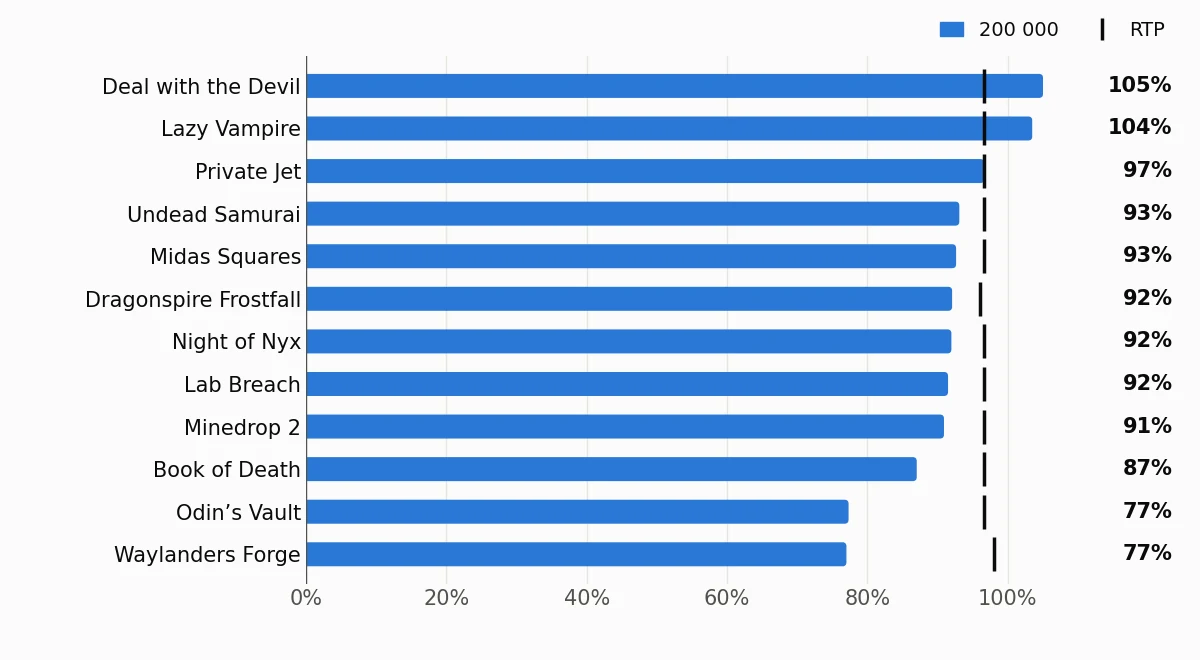
Even over 200 000 spins — years of play for one person — the actual return in nine games out of twelve turned out below the stated RTP, in two it was above, and in only one did it match. There is one reason: the biggest wins, which carry part of the RTP, simply did not land in that time.
The longer the distance, the narrower the spread. Here is one slot — Private Jet with an RTP of 96.7%: the range in which the result fell for eight sessions out of ten.
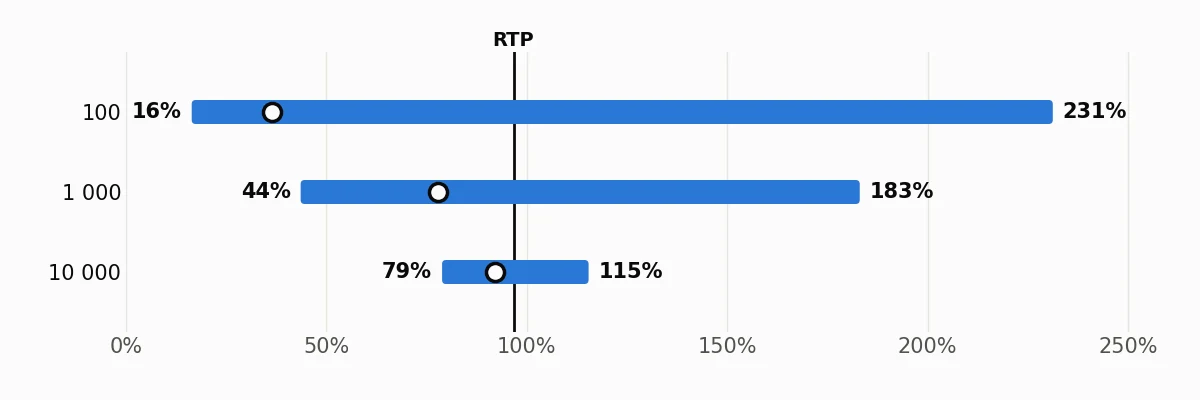
Over 100 spins a typical session returned 37% of the budget, and eight sessions out of ten fell between 16 and 231%. Over 10 000 spins it was already 92%, with a range of 79 to 115%. The game approaches the stated 96.7%, but slowly.
RTP and volatility: what is the difference
RTP answers the question “how much comes back on average”. Volatility answers the question “how exactly”: often and in small amounts, or rarely and in big ones.
| What we compare | Low volatility | High volatility |
|---|---|---|
| Payouts | Frequent, small | Rare, big |
| Dead runs | Short | Long |
| Budget for 100 spins | Spent more slowly | Spent faster |
| Maximum Payout | Usually more modest | Usually higher |
| RTP | Can be the same | Can be the same |
An example from the same data. The slot Lazy Vampire has five published variants of one mode with the same RTP and different volatility. After 100 spins a typical session keeps from 13% of the budget in the harshest variant to 72% in the softest.
That is why two slots with the same RTP can feel completely different. More in our article on slot machine volatility - Slots volatility.
What RTP counts as high
Instead of guessing, we looked at how base-mode RTP is distributed across 7 649 games.
| Base-mode RTP | Games | Share | How to rate it |
|---|---|---|---|
| below 94% | 195 | 3% | Low |
| 94 to 95.99% | 667 | 9% | Below usual |
| 96 to 96.7% | 6 448 | 84% | Standard |
| above 96.7% and up to 97.99% | 280 | 4% | Above usual |
| 98% and above | 59 | 1% | Rare |
The conclusion is simple: 96–96.7% is not a “high RTP” but the norm. Truly high values start at 97% and are rare.
And a high RTP does not make a game soft. The slot Waylanders Forge has an RTP of 98% — the highest among the 12 we checked. Yet after 100 spins a typical session kept 15% of the budget in it, and over all 200 000 spins the game returned 77%.
Where to find a slot’s RTP
- In the game itself. Open the menu, the rules or the paytable — usually it is the “i” button or the three bars. The RTP is stated there.
- At the casino where you play. Many providers release one and the same slot in several RTP versions, and the casino chooses which one to run. The figure from a review may not match the figure in your game.
- For your own mode. A regular bet, a boosted bet and a bonus buy are separate modes, and their RTP may differ.
- In public data. Some platforms publish the maths of their games in full — then the RTP and the chance of the max win can be checked before the first bet.
We have a separate piece on the buy mode: Slots with a bonus buy feature - Online casino bonus buy slots.
Myths about RTP
| Myth | How it really is |
|---|---|
| “A slot with an RTP of 96% will give me back 96 out of 100” | It is an average over millions of spins and across all players at once. Over 100 spins a typical session in the slots we checked returned 10 to 43% |
| “After a dead run the slot has to pay” | A slot has no memory: the chance of every spin is the same, whatever came before it |
| “A high RTP means frequent wins” | Payout frequency is set by volatility, not by RTP |
| “The casino changes the RTP to suit the player or the time of day” | In licensed slots the RTP is built into the game’s maths. The casino can choose one of the ready-made versions but cannot change it mid-game |
| “An RTP of 100% means you cannot lose” | That is an average too: a single session can end either in profit or at zero |
Does 100% RTP exist
In slots from third-party studios — practically not. We checked 117 521 modes of games on the Engine platform: none reaches even 99.9%, and the maximum is 98.95%.
A zero house edge is found in the in-house games of certain crypto casinos — Dice, Mines, Plinko and the like. But there, too, it is an average over the long run, not a guaranteed result.
How to use RTP in practice
- Compare games, do not predict a session. RTP helps you choose between two slots, but it does not say how the evening will end.
- Check the RTP of your version and your mode. The figure in the game itself matters more than the figure in a review.
- Take volatility into account. It has a stronger effect on how many spins your budget will last.
- Count your budget in spins. Decide in advance how many spins and how much money you are ready to spend, and do not raise the bet after a dead run.
- Do not expect RTP to “kick in”. It is under no obligation to show up in a single session — neither in your favour nor against you.
How a slot works inside — in our article on how a slot machine works - machine Casino Slot. How to pick a game that suits you — in our guide on how to choose slots - Slots.
Frequently asked questions about RTP
What is RTP in plain words?
It is the percentage of all bets that a game returns to players as winnings over the long run. With an RTP of 96%, out of every 100 coins staked players collectively get 96 back and 4 stay with the casino.
Is an RTP of 96% a lot or a little?
It is the norm. In 84% of the 7 649 games we checked, base-mode RTP lies between 96.00 and 96.70%. An RTP of 97% or more can be considered high.
How do I find out a slot’s RTP?
Open the rules or the paytable in the game — the RTP is stated there. Look at the figure at the exact casino and in the exact mode you play: one slot can have several RTP versions.
Are RTP and volatility the same thing?
No. RTP shows how much comes back on average, while volatility shows how payouts are distributed: often and in small amounts, or rarely and in big ones. Games with the same RTP can behave completely differently.
Can a casino change a slot’s RTP?
In licensed slots the RTP is set by the provider. The casino can choose one of the ready-made versions of a game, if the provider releases them, but cannot change it during play. That is why the figure is worth checking in the game itself.
Are there slots with 100% RTP?
Among the 117 521 modes of games on the Engine platform there are none: the maximum is 98.95%. A zero house edge is found only in the in-house games of certain crypto casinos.
Why do I lose faster than RTP promises?
Because RTP is an average over millions of spins. Over a short stretch most spins are dead and big wins are rare. In the 12 slots we checked, only 14–25% of sessions ended in profit after 100 spins.
How we calculated
- Source. Engine’s public fairness verification service: the game catalogue and mode statistics. No data on real player bets was used.
- Snapshot date. 11 November 2026. Games in the catalogue: 7 649; modes: 117 521; spin statistics were obtained for 7 486 games.
- Sessions. 12 games × 200 000 reproduced base-mode spins. The spins were cut consecutively into 2 000 sessions of 100 spins, 200 sessions of 1 000 and 20 sessions of 10 000. For sessions of 10 000 spins the estimate is rough.
- Bet. One coin per spin, one mode, no bonus buys.
- Rounding. Shares are rounded to whole percentages, so their sum may differ from 100%.
🔞 Play responsibly. Gambling is entertainment, not a way to make money: in the long run the edge stays with the casino. Do not bet money you cannot afford to lose. Help is free and confidential: BeGambleAware.org - Link | GamCare - Link